An agent assist bot is quickly becoming one of the most powerful tools in modern customer service and sales teams. With the rise of AI Call Center Solutions - iLounge, these smart assistants are built to help agents, not replace them, by surfacing answers, suggesting the next best action, and taking care of repetitive tasks. This is especially helpful in AI Call Center Solutions For Remote Workforces, where agents working from home or distributed locations can get instant support to provide faster, more consistent customer service.
Beyond the call center, AI is transforming the way businesses operate across multiple industries. Companies are now using cloud computing systems integrated with artificial intelligence for businesses, big data analytics powered by AI for smarter insights, and modern computer technology infrastructure for seamless operations. These tools also enhance digital marketing campaigns using AI for better audience targeting, AI-assisted strategies for personalized marketing efforts, and financial decision-making with artificial intelligence models for accurate forecasting.
By combining these technologies, organizations can automate daily operations using AI-driven solutions, improve customer engagement with AI-powered support, and analyze financial trends using predictive AI systems. The same technology that powers an agent assist bot can help companies unify cloud-based AI platforms for optimized workflows, create data-driven marketing initiatives using artificial intelligence, and strengthen financial management with AI-assisted predictive models.
This guide breaks down what an agent assist bot is, how it works, the benefits you can expect, and how to implement one successfully in your organization, showing how AI is transforming both customer service and broader business operations.
Top AI Contact Center Solutions: Bright Pattern and Competitors
If you’re exploring solutions to improve customer service and agent productivity, an agent assist bot is essential. These AI-driven tools help call center agents surface answers, suggest next actions, and handle repetitive tasks. Bright Pattern is a leading platform in this space, offering robust features for AI contact center and call center solutions. Here’s a look at Bright Pattern and nine competitors to help you choose the right solution for your organization.
1. Bright Pattern

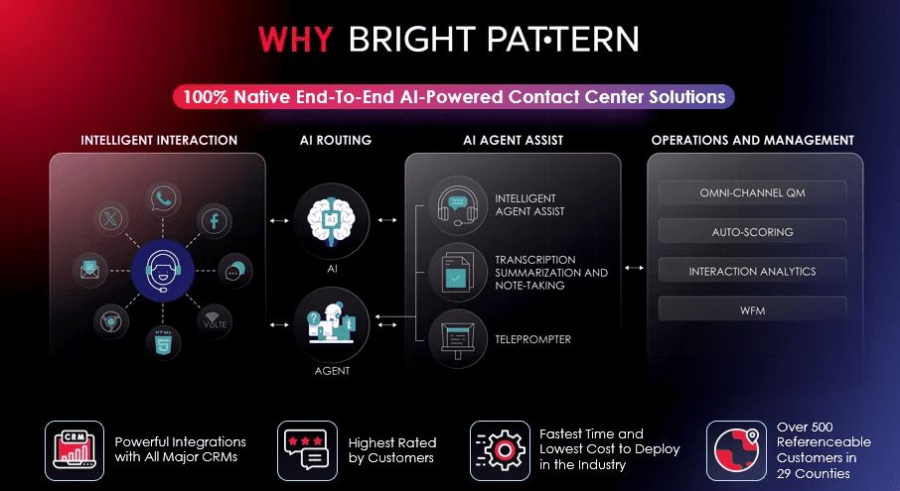
Bright Pattern stands out as a top choice for AI contact center solutions because it combines advanced automation, cloud-based architecture, and agent assist features to enhance customer engagement. The platform is ideal for both small teams and enterprise-level operations, offering tools that support omnichannel communication and real-time analytics.
Key features:
- AI-powered agent assist bots to provide live guidance
- Omnichannel support including voice, chat, email, and social media
- Cloud-based infrastructure for scalability and reliability
- Analytics dashboards for performance tracking
- Easy integration with CRM and business system
2. Genesys Cloud
Genesys Cloud offers AI-driven call center solutions with smart routing, automated workflows, and real-time agent assistance to boost productivity and customer satisfaction.
3. Five9
Five9 provides cloud-based call center solutions with AI capabilities for predictive dialing, agent assist, and omnichannel support for better customer engagement.
4. NICE inContact CXone
CXone from NICE inContact leverages AI for automated routing, agent guidance, and advanced reporting to optimize contact center operations.
5. Talkdesk
Talkdesk uses AI to deliver intelligent agent assistance, workforce optimization, and unified communication across multiple channels for seamless customer experiences.
6. RingCentral Contact Center
RingCentral integrates AI-powered features like automated call distribution and agent assist bots, helping teams manage customer interactions more efficiently.
7. Avaya OneCloud
Avaya OneCloud combines AI-driven assistance and cloud-based solutions to provide real-time guidance for agents and enhance overall customer service performance.
8. 8x8 Contact Center
8x8 offers AI-enabled call center solutions, including agent assist features, analytics, and omnichannel support to streamline customer service operations.
9. Talkdesk CX Cloud
Talkdesk CX Cloud provides AI-powered agent assistance, predictive analytics, and workflow automation for improved efficiency and customer satisfaction.
10. Cisco Contact Center
Cisco Contact Center delivers AI-enhanced call routing, real-time agent support, and reporting tools to optimize customer interactions and agent productivity.
What Is an Agent Assist Bot?
Anagent assist botis an AI-powered assistant that worksalongsideyour human agents in real time. It listens to conversations (via text or speech transcripts), analyzes context, and then proactively suggests:
- Relevant knowledge base articles and snippets
- Accurate, compliant response suggestions
- Next best actions and workflows
- Forms, templates, or macros to use
- Customer history, sentiment, and key account details
Unlike a customer-facing chatbot, an agent assist bot stays behind the scenes. It does not talk directly to the customer; instead, it guides the agent, who keeps full control of the conversation.
Why Agent Assist Bots Are a Game-Changer
Agent assist bots unlock value at every level of your organization — from individual agents to team leaders to customers.
Benefits for Agents
- Instant answers at their fingertips.No more hunting through multiple tools and tabs; the bot surfaces the most relevant content immediately.
- Less cognitive load.Agents can focus on listening and empathy while the bot helps with searching, drafting, and summarizing.
- Faster onboarding.New hires become productive sooner because the bot acts like a real-time coach, guiding them through unfamiliar scenarios.
- Higher confidence.Real-time suggestions and compliance prompts reduce guesswork and anxiety during complex interactions.
Benefits for Team Leaders and Operations
- More consistent quality.Standardized responses and recommended workflows help every agent follow best practices.
- Scalable coaching.Instead of one-on-one shadowing for every call, the agent assist bot can provide on-the-spot support to the entire team.
- Actionable insights.Aggregated data on common questions, friction points, and successful responses informs process improvement.
- Better use of expert time.Subject-matter experts spend less time answering repeat questions and more time on strategic work.
Benefits for Customers
- Faster resolution.With suggested answers and workflows, agents resolve issues more quickly and confidently.
- Fewer transfers and handoffs.Agent assist bots help frontline agents handle a broader range of topics without escalation.
- More accurate, consistent information.The bot pulls from a single source of truth, reducing contradictory or outdated advice.
- More human conversations.When agents are freed from endless searching and manual note-taking, they can be more present, empathetic, and engaging.
How an Agent Assist Bot Works (Behind the Scenes)
While the user experience is simple, effective agent assist relies on several powerful technologies working together.
- Capture.The bot ingests data from the active interaction. This might be live chat messages, email content, or a real-time transcript of a voice call.
- Understand.Natural language processing analyzes the customer request, intent, sentiment, and key entities such as product names, order numbers, or account types.
- Search and reason.The agent assist bot consults knowledge bases, FAQs, previous tickets, and policies to find the most relevant information and infer likely next steps.
- Suggest.It presents concise recommendations to the agent: drafted responses, knowledge snippets, process steps, or internal notes.
- Learn and improve.Over time, the system analyzes which suggestions are accepted, edited, or ignored, and uses that feedback to improve future recommendations.
The result is a smooth, low-friction experience for the agent: helpful suggestions pop up at the right time, in the right place, inside the tools they already use.
High-Impact Use Cases for Agent Assist Bots
Agent assist bots can support a wide range of workflows across customer support, sales, and internal service desks. Here are some of the most impactful use cases.
1. Real-Time Response Suggestions
As the customer types or speaks, the agent assist bot drafts recommended replies for the agent to review, personalize, and send. This is especially powerful for:
- Frequently asked questions around billing, orders, account access, and troubleshooting
- Standardized compliance or legal language that must be worded precisely
- Consistent tone guidelines across regions, teams, and channels
Agents stay in control, but the blank-screen problem disappears. Every response starts from a strong, on-brand foundation.
2. Knowledge Surfacing and Contextual Search
Instead of forcing agents to manually search knowledge bases, an agent assist bot proactively suggests:
- Relevant articles and sections
- Technical troubleshooting steps
- Internal process documentation
- Product or policy updates that affect the current case
This helps unlock the full value of your documentation and ensures it is actually used during customer interactions.
3. Workflow and Process Guidance
Complex processes — such as identity verification, refunds, or regulatory disclosures — can be streamlined with real-time guidance from an agent assist bot. It can:
- Prompt agents for required data fields in the right order
- Flag missing information or exceptions
- Recommend escalation paths when needed
- Remind agents of mandatory compliance steps
This reduces errors, speeds up complex tasks, and keeps processes compliant without constant manual supervision.
4. Real-Time Coaching and Soft-Skills Support
Beyond content and processes, agent assist bots can support the human element of service by:
- Flagging customer frustration or churn risk based on language and sentiment
- Prompting empathy phrases or de-escalation techniques
- Suggesting upsell or cross-sell opportunities when appropriate
- Reminding agents of personalized details, such as customer history or preferences
This turns every interaction into an opportunity to build stronger customer relationships.
5. After-Call Work and Case Summaries
Agent assist does not stop when the conversation ends. It can accelerate post-interaction work by automatically:
- Drafting case summaries and internal notes
- Highlighting key decisions, commitments, and follow-up tasks
- Tagging the interaction with relevant categories and topics
- Updating certain fields in the ticket or CRM (when configured)
Agents spend less time on repetitive documentation and more time helping the next customer.
Key Features to Look For in an Agent Assist Bot
Not all agent assist solutions are the same. When evaluating options, focus on capabilities that drive real, measurable value for your team.
1. Strong Natural Language Understanding
Your agent assist bot should accurately understand diverse ways customers describe the same issue, across channels and languages where needed. Look for:
- High-quality intent detection for your domain
- Support for the key languages your customers use
- Ability to extract entities like order IDs, product names, and account types
2. Deep Knowledge Integration
The more seamlessly the bot integrates with your existing content, the more powerful it becomes. Valuable integrations often include:
- Knowledge bases and FAQ repositories
- Internal documentation and playbooks
- Ticket history and CRM records
- Product catalogs and policy documents
Ideally, updates to your knowledge are reflected in agent assist suggestions with minimal delay.
3. Real-Time, Low-Latency Performance
To truly assist rather than slow agents down, suggestions must appear quickly and reliably. A strong solution delivers recommendations fast enough to fit the natural flow of conversation.
4. Configurability and Control
Business teams should be able to adjust and optimize the bot without heavy engineering involvement. Look for:
- Configurable triggers and conditions for when suggestions appear
- Editable templates and response snippets
- Granular controls by team, queue, or use case
- Easy experimentation and A/B testing of new flows
5. Robust Analytics and Feedback Loops
Agent assist gets better as it learns. To enable that, you need visibility into:
- Which suggestions agents accept, edit, or dismiss
- Impact on handle time, resolution, and satisfaction
- Topics where suggestions are missing or underperforming
- Adoption across teams and agents
Continuous improvement turns a good agent assist bot into a great one.
Implementing an Agent Assist Bot: Step-by-Step
A thoughtful rollout maximizes adoption and value. Here is a practical sequence to follow.
Step 1: Define Clear Goals and Success Metrics
Start by aligning stakeholders on what you want to achieve. Examples include:
- Reducing average handle time for support conversations
- Improving first contact resolution for key topics
- Shortening new agent ramp-up time
- Increasing customer satisfaction scores
Having specific goals helps you prioritize features, measure impact, and communicate success.
Step 2: Choose High-Impact Use Cases for a Pilot
Start where an agent assist bot can win quickly. Ideal starting points often share these traits:
- High volume of similar questions or processes
- Well-documented knowledge and clear policies
- Moderate complexity that still benefits from human oversight
- Motivated team leaders eager to experiment and improve
A focused pilot lets you fine-tune the experience before expanding across teams.
Step 3: Integrate With Your Existing Tools
For agents, simplicity is everything. The agent assist bot should appear directly inside the tools they already use, such as:
- Ticketing and case management systems
- Live chat and messaging platforms
- Contact center or dialer interfaces
- Internal service desk portals
Minimal context-switching encourages adoption and makes the assistance feel natural instead of disruptive.
Step 4: Prepare and Curate Your Knowledge
High-quality input leads to high-quality suggestions. Before launch, invest in:
- Reviewing and updating key knowledge articles and macros
- Standardizing terminology and product names
- Clarifying edge cases and escalation criteria
- Tagging or structuring content for easier retrieval
This foundation lets the agent assist bot deliver accurate, trustworthy guidance from day one.
Step 5: Train and Involve Your Agents
Agent buy-in is critical. Position the tool clearly as a co-pilot that makes their job easier, not a monitoring system. Effective enablement often includes:
- Hands-on training sessions with live examples
- Clear guidelines on when to accept, edit, or ignore suggestions
- Feedback channels for agents to suggest improvements
- Recognition for agents who champion and optimize usage
When agents feel heard and supported, adoption grows quickly.
Step 6: Launch, Monitor, and Iterate
Once live, track both quantitative and qualitative feedback:
- Performance metrics against your initial goals
- Agent sentiment and suggestions
- Customer feedback trends and themes
- Topics where suggestions are missing or incomplete
Use this data to refine prompts, update content, and gradually expand to new teams and use cases.
Measuring Success: KPIs and Metrics That Matter
To showcase the impact of your agent assist bot, track a balanced set of metrics across productivity, quality, and experience.
|
Metric |
What It Measures |
How Agent Assist Helps |
|
Average handle time |
Time agents spend resolving each interaction |
Faster answers, fewer manual searches, streamlined workflows |
|
First contact resolution |
Percentage of issues resolved in a single interaction |
Better knowledge access and guidance reduce repeat contacts |
|
Customer satisfaction |
Customer-reported quality of the interaction |
Quicker, more accurate, and more empathetic conversations |
|
Agent ramp-up time |
Time for new hires to reach target productivity |
Real-time coaching and guidance accelerate learning |
|
Quality assurance scores |
Compliance and adherence to standards |
Standardized templates and process prompts improve consistency |
|
Agent satisfaction |
How agents feel about their tools and workload |
Reduced stress and repetitive work increase engagement |
Tracking these metrics over time helps you tell a clear story about the value your agent assist bot delivers.
Best Practices for Long-Term Success
Agent assist is not a one-time project; it is an evolving capability. These practices help sustain and grow its impact.
Keep Humans in the Loop
Use your agents as partners in improvement. Encourage them to:
- Edit suggestions so the system learns from better versions
- Flag inaccurate or outdated content for review
- Propose new scenarios and playbooks to automate
This feedback loop keeps the bot aligned with real-world needs.
Continuously Refresh Knowledge
Your products, policies, and processes will evolve. Make knowledge maintenance a regular habit so the agent assist bot always reflects the latest information.
Design for Transparency and Trust
Agents are more likely to rely on suggestions when they understand where they come from. Whenever possible, show:
- Source articles or policies behind a recommendation
- Reasoning or context used to generate advice
- Options, not just a single answer, for complex cases
Transparent assistance encourages confident use.
Start Focused, Then Expand
Begin with a concentrated set of use cases where the agent assist bot can clearly excel. After demonstrating value, expand to:
- New channels such as voice, chat, or messaging
- Additional departments like sales or internal IT support
- More complex, multi-step workflows and transactions
This phased approach builds momentum and supports continuous learning.
The Future of Agent Assist: From Helper to Co-Pilot
The capabilities of agent assist bots are advancing rapidly. Looking ahead, organizations can expect even more value as agent assist evolves from a passive helper into a proactive co-pilot.
- Smarter predictions.Anticipating customer needs earlier in the interaction, not just reacting to explicit questions.
- Deeper personalization.Tailoring recommendations based on customer history, preferences, and journey stage.
- Richer automation.Handling more routine back-office steps automatically while keeping humans in charge of decisions.
- Broader collaboration.Supporting cross-functional workflows that span support, sales, success, and operations.
Organizations that invest in agent assist now build a strong foundation for future AI-powered experiences.
Getting Started: A Simple Action Plan
If you are considering an agent assist bot, here is a concise plan you can act on quickly:
- Clarify your primary goal, such as faster resolution or improved agent ramp-up.
- Identify one or two high-volume, well-documented use cases as a starting point.
- Ensure your key knowledge and macros for those use cases are current and easy to understand.
- Involve frontline agents early, gather their input, and frame the bot as a co-pilot.
- Launch a focused pilot, measure impact, and iterate based on data and feedback.
- Scale to more teams and workflows once you see consistent, positive results.
With the right strategy, an agent assist bot can quickly become a competitive advantage for your service organization — boosting productivity, elevating customer experiences, and helping your agents do their best work every day.
